Spreading Christmas Cheer to Nantwich via Piano Music
- Jack Mitchell Smith

- Dec 16, 2025
- 8 min read
It’s been a difficult year this year. That is to say, the last three months have. Not a topic of conversation for this particular blog, but at some point it was fair to say that my break from playing for both myself and for others was going to have to start again.
Fortuitously for me, it happened to coincide with round about the beginning of November and - knowing that I was scheduled to visit the lovely residents of Richmond Villages in Nantwich again on Wednesday 3rd December - it seemed like the perfect opportunity to start reassessing my Christmas / festive repertoire.
I learnt a few more and revisited some I’ve done before and went to visit as promised on 3rd December and was so glad to be back performing for them. They loved every moment as usual, and it was - being Christmas and all - just an even warmer atmosphere than I might have been used to.
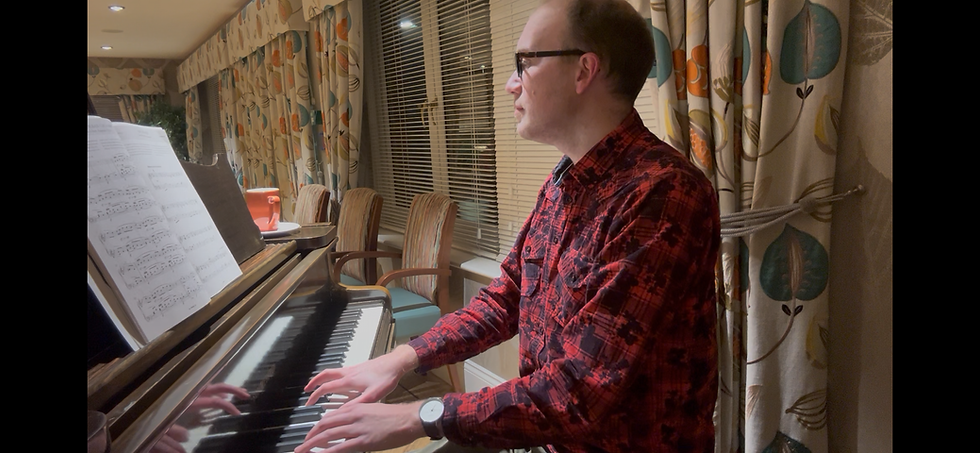
My full disclosure begins now, however, in that I was not on top form in playing and to me that was obvious whilst playing and whilst watching all the videos back (first time I’ve visited and recorded every piece). But I present them all here in them unashamed glory!
So enjoy some videos of me performing some Christmas piano music for the lovely residents of Nantwich on Wednesday 3rd December 2025!
Christmas Piano Music in Nantwich
God Rest Ye Merry Gentlemen - arr. Steve Langford
This was an arrangement from last year’s issue of Pianist magazine, which I normally like to buy around the festive period for their Christmassy / Wintery pieces as I just love immersing myself and not being too obvious. As this year’s was only released a few days ago, I went back to last year’s to give myself at least a fighting chance of a decent performance! I was very happy with how it went, though!
According to their writeup pre-score, Steve Langford won their 2023 composition competition. Seeing as I consider that he gave me more interesting repertoire to expand into than a bog-standard rendition of this hymn (this arrangement is very much a jazz waltz when it gets going!), it’s only fair that I link here to that winning piece so you can hear the true extend of his skill.
And here’s my performance of his arrangement:
Franz Liszt - Weihnachtsbaum
I’m going to say it - I’m in love with this suite!
The thing with Liszt is that we all know him as a virtuoso. He was literally the original rockstar of music (seriously - Lisztomania was a thing - look it up!). So with that comes an expectancy that everything he writes is seriously over the top and complicated, right?
Wrong!
Even somebody as mega-talented as Liszt knew that there was charm and wonder in the simplistic as well, as he composed and / or arranged a set of festive pieces into a short - sadly largely forgotten - suite known as Weihnachtsbaum (Christmas Tree). From the joyous celebration of the pure, chunky chords of the opening Psalitte to the quiet, reflective mood of Ehemals, he encapsulated such a diverse range of emotion that is so associated with this period of time whilst always keeping his music uncharacteristically accessible to your average pianist (hello).
I performed four pieces - the first three went in order from the beginning, and then I jumped forward for a more reflective one for my fourth:
Psalitte (Old Christmas Carol)
One of the things that sometimes gets lost in classical / romantic music is the purity of chords because of its surrounding complexity of arrangement, however Liszt created a beautiful, simple opening for his suite by using full F, C / C7, B♭ and D minor chords to startling effect. The contrast in dynamic from its powerful, full opening to the sweeter (dolce) chords in the higher register are wonderful.
Sadly, my not very well warmed up fingers didn’t do so well on the octave pattern in the left hand at the approximate halfway point, however I tried to ensure this didn’t affect the flow. Nobody seemed to mind or notice, and hopefully you won’t notice either (unless you’ve read this!).
O Holy Night!
This has surely got to win the award for the easiest piano piece in Liszt’s entire catalogue, but don’t be fooled. It still requires a delicate balance between the two hands, despite them playing separately for the majority of the piece (call and response). It’s not all that more of a challenge when the hands play together, mind, although my right hand couldn’t quite make an octave F the first time it needed to as you may hear (what was wrong with my octaves?!).
The Shepherds at the Manger (In Dulce Jubilo)
A very familiar carol given the Liszt twist (well that should be a phrase!).
The left hand carries the piece forward for the most part in a nice, lilting way whilst the right hand uses full chords or intervals - both topped with the appropriate note - to progress both harmony and melody.
Ehemals (Formerly)
This was the first piece from this suite that I learnt, and perhaps my favourite. To me, it delivers something magical that the others don’t quite, and I think perhaps it is that melancholy. Christmas is so associative of joy and fun etc. which is wonderful, but a large part of it is the remembrance. I don’t think I know a piece of music that captures nostalgia at Christmas quite like this (not just amongst the classical repertoire). And that’s quite extraordinary, considering that it’s not even a piece I’ve known for all that long - couple of years, maybe. But as soon as I heard it, it just felt like the quieter part of Christmas. Perhaps it’s the chordal structure. Perhaps it’s the twinkly notes when we develop the melody into the higher register. I don’t know - any music psychologist reading please feel free to enlighten me but meanwhile - enjoy this magnificent piece!
In the Bleak Midwinter - arr. Derry Bertenshaw
From an older issue of Pianist, this arranger is also a former winner of their composition competition (2015, I believe). Sadly, I can’t link to a video for him as I can’t find one, but I would like to extend personal thanks to him as well for expanding my repertoire to a much more interesting rendition of this piece than I may otherwise have delivered. Unfortunately, I didn’t deliver a great performance - ordinarily I like to learn to play pieces for an audience without the score as my dependance on them becomes an unwelcome distraction which - unfortunately - made its unwelcomeness known a few times throughout my rendition. However, everybody enjoyed it.
What is beautiful about this arrangement aside from its throwing out of the harmonies we may be more familiar with from Holst’s original composition (Cranham) and replacing them with jazzier ones, is a middle section whereby we get a call and response that is slightly out of the ordinary. And by slightly, I mean very - we stay in the key on D major for the melody in the left hand, but each phrase of the melody is repeated in the right hand in the key of G major. The notation remains in the key of D, so there are an exciting amount of accidentals in the right hand. It creates such an unusual but such a thrilling listening experience before we get a much more familiar take of the piece in one in a brand new key again - B♭ . For those counting, the opening key is actually F major, so there are in fact 4 keys in total playing the melody of this piece (although two of them are kind of mushed together!).
Enjoy!
Prelude VI - Des Pas Sur La Neige - Claude Debussy
I have performed this piece before, but it is one that I love at this time of year because it is seasonal / wintery. Its English title is ‘Footsteps in the Snow’ - which is basically a like for like translation.
This is an interesting piece of music in that it doesn’t focus on delivery much by way of melody so much as by way of feels. Debussy takes an idea (literally footsteps in the snow) and works with that to create more of a soundscape than a recognisable tune or theme. And I’m all here for that.
For the record, this is how much of Debussy is. He can be a very hit and miss composer because a lot of people don’t go for the ‘non-melodic’ approach to music; they prefer tunes etc. However, where I almost guarantee that I get away with this one with 100% success rates for my crowds is that it is extremely dreamy and not unpleasant on the ear, despite not necessarily having a discernible musical theme.
The Bells
Going back to last year’s issue of Pianist magazine, they were very taken with the idea of bells. So I performed some of these piece!
La Cloche Sonne - Franz Liszt
My previous statements about Liszt remain in that he knew when he needed to be a little more ‘straightforward’ with his music. Here is a perfect example. A simple melody and one that I like to punctuate with unmarked B♭s in the left hand when it gets to the middle section, so as to give the idea of a tolling bell.
Where We Hear An Old Music Box - Déodat de Séverac
Another piece that my fingers weren’t quite warmed up for, truth be told, but I got through it and it was OK. A lovely piece that had my fingers been better prepped would have been even more like a music box, not so much because of its sound but because of its relentlessness of a piece. Imagine winding up a music box and it just goes on and on at the same speed until just at the end where it loses steam. That’s the thing we’re going for.
It still sounded OK though.
Les Cloches - Charles-Valentin Alkan
Perhaps one of my favourite short pieces for solo piano, and one that is as much a challenge as any other despite its relatively straightforward appearance. The trick is to create an illusion of chiming bells with the smaller finger of the left hand throughout the piece, whilst the right hand plays a melody and the remaining left hand fingers follow the melody in a similar pattern but using different notes to create a beautiful harmony.
Les Cloches du Soir - Camille Saint-Saëns
And welcome to probably my favourite piece from this whole section. There are a few opportunities to let notes ring out like bells - they’re quite obvious. But the whole movement of this piece is wonderful, with a lovely melody which extends to opposite ranges of dynamic in such a wondrous way, and it is repeated again in a different key but using the right hand to create a chiming harmony whilst this time around the left hand takes the bulk of the main melody.
Saint-Saëns is one of these composers whose name gets thrown around piano repertoire a lot, but I must confess he is new to me. But what a wonderful place to start!
A Dream About Silent Night - Carl Nielsen
And to finish - something dreamy.
A beautiful arrangement of the opening lines of our favourite carol - Silent Night. And when I say arrangement, I think ‘improvisation’ might be an even better term. It takes the theme and runs with it. Actually, it runs away with it. Much of these piece is beyond recognition of its source material but it always keeps coming back to it and that’s just fine. It’s dreamy, it’s reflective and it’s beautiful and it’s the perfect ending!
Jack Mitchell Smith is a piano teacher based in Congleton, Cheshire. Click here to find out more.
Weekly blogs are posted that may help you with your musical or piano journey. Click here to sign up to the mailing list so you never miss a post!


Comments